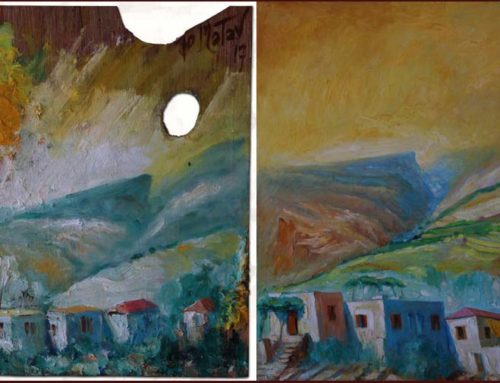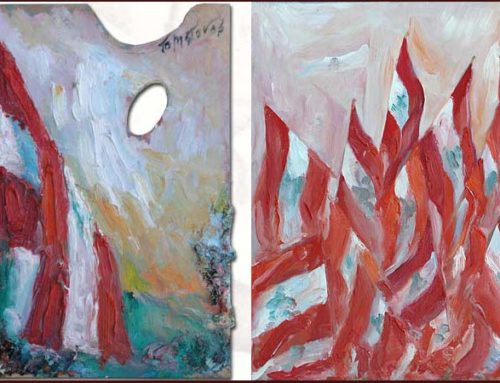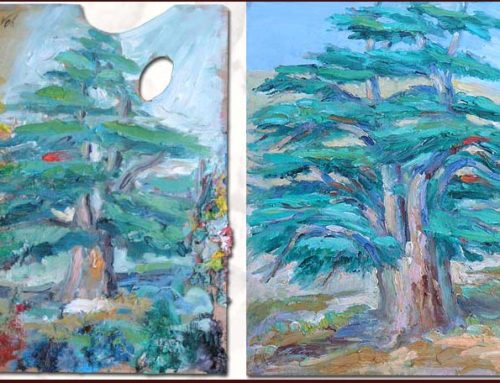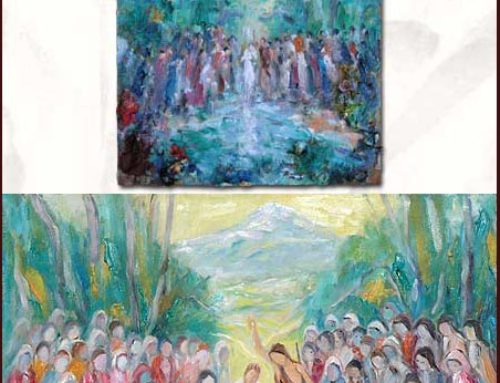


Four Trees, Four Symbols
The Vine, the Olive, the Cedar, and the Carob Tree
By Joseph Matar – See the painting
Since the earliest times, humankind has never viewed trees as mere elements of the landscape. They have been given names, virtues, and symbols. Some have nourished their bodies, others have built their homes, lit their nights, or accompanied their prayers.
Among them, four hold a special place in our history and in our collective imagination: the vine, the olive, the cedar, and the carob tree. They differ in form, fruit, and use, but they share something in common: each, in its own way, tells a story of humankind, the earth, and the divine.
The Vine, Tree of Life and Communion
The vine is one of the plants most laden with symbolism. Since antiquity, it has represented life, fertility, prosperity, and wisdom. Its fruit yields wine, a beverage that, in many civilisations, has been associated with the gods, celebration, and mystery. In biblical tradition, the vine holds a central place.
It can represent the people, the promised land, or the bond between God and humankind. The prophet Isaiah dedicated his famous Song of the Vine to it. Noah, after the Flood, is presented as one of the first to plant a vineyard. In the New Testament, the image becomes even more powerful. Christ says, “I am the true vine,” while God is presented as the vinedresser. The vine then becomes the image of humanity, which can only bear fruit by remaining connected to its source. Its bunches of grapes are numerous, but they all belong to the same vine.
This image is perhaps one of the most beautiful: that of many different beings, nourished by the same root. In Christian symbolism, wine also becomes the wine of the Eucharist, a sign of covenant, communion, and spiritual life.
In ancient civilizations, the grapevine was also associated with youth, light, and the renewal of life. Its grapes were even sometimes compared to stars, as if the plant linked earth and sky.
Thus, in a single grape, the earth, the sun, human patience, and time converge.
The Olive Tree, Tree of Peace and Light
The olive tree possesses another strength. It doesn’t seduce with the abundance of its fruit or the grandeur of its trunk. It impresses with its resilience. It can live for centuries. Its wood is hard, its roots deep, and its foliage remains vibrant under the sun and in drought. For millennia, it has symbolized peace, strength, victory, and wisdom.
After the Flood, according to the biblical account, the dove returned to Noah with an olive branch. Since then, this branch has become, in the universal imagination, one of the most powerful symbols of peace. For the Greeks, the olive tree was linked to Athena and the city of Athens. It represented such precious wealth that its destruction could be considered a grave sin.
But the olive tree is not only a symbol. It nourishes. Its oil has been a companion to humankind for millennia. It is used for cooking, for healing, and, in the past, especially for lighting. This is why the olive tree is intimately linked to light.
This dimension takes on a particularly profound meaning in the Islamic tradition. The Quran refers to the olive tree as a “blessed tree,” notably in the famous Verse of Light, where the oil is associated with an almost spiritual clarity.
Thus, the olive tree exists between the material and the spiritual. Its fruit nourishes humankind, its oil illuminates the home, and its symbolism illuminates the mind. Tree of peace, blessed tree, tree of light: it transcends religions and civilizations, carrying everywhere a message of continuity and hope.
The Cedar, Tree of Eternity
Then comes the cedar. And when we say the cedar, our thoughts naturally turn to Lebanon. It is the tree of grandeur, nobility, strength, and immortality. Its wood withstands the test of time. It rots only very slowly. Its fragrance lingers. Its stature towers over the mountains. Ancient civilizations had already understood its value. The Egyptians used its wood and resin. The Phoenicians built ships from it capable of crossing the Mediterranean. The peoples of antiquity used it for palaces, temples, sculptures, and sacred objects.
In biblical tradition, the cedar of Lebanon is mentioned numerous times. Solomon’s Temple was built with cedar wood from Lebanon. Its solidity became an image of moral and spiritual grandeur. Because it resists time and decay, it was also considered a symbol of the enduring soul. The cedar tree thus seems to embody the idea of eternity. Its roots plunge into the mountain, while its branches reach towards the sky. Perhaps this is why it has become the symbol of our country. Lebanon could have chosen many other emblems. It chose a tree. A tree that endures through the ages. A tree that has witnessed the passing of peoples, wars, empires, and religions. A tree that remains standing.
The Carob Tree, a Generous Tree
The fourth tree is less majestic. It lacks the grandeur of the cedar, the renown of the olive tree, and the sacred dimension of the vine. And yet, it perhaps deserves just as much of our respect.
It is the carob tree. One could call it the generous tree, or even the poor man’s tree. For centuries, when sugar was scarce and expensive, the carob tree naturally offered a sweet fruit to those who could not afford honey or other sweets. It grows bravely in difficult soils. It withstands heat, wind, rain, and winters. It asks for little, but gives much. Its long, brown pods can be eaten directly or processed into flour and, above all, molasses.
Starting in late summer, the fruits are harvested, dried, ground, and then processed with water and heat to extract a dark, sweet, and nutritious molasses. This molasses has nourished generations. Even today, it is used in the preparation of many desserts, and some renowned chefs are rediscovering its richness.
The carob tree also has a profound social dimension. In the past, even a humble person could care for a carob tree, cultivate it, harvest its fruit, and benefit from its bounty. A tree could become a small source of wealth. Not wealth reserved for the powerful. Wealth offered by the earth. Perhaps this is why the carob tree is, in its own way, a democratic tree. Its fruit doesn’t ask who you are before it nourishes you.
Four Trees, One Story
Thus stand four trees before us. The vine speaks to us of life and communion. The olive tree speaks to us of peace and light. The cedar speaks to us of strength and eternity. The carob tree speaks to us of generosity and sharing.
Four trees, four distinct personalities. But also four lessons.
The vine reminds us that fruit springs from the roots.
The olive tree teaches us that it is possible to endure for a long time without losing our capacity to give.
The cedar teaches us the dignity of remaining standing despite the passage of time.
The carob tree reminds us that true wealth is not always what glitters: sometimes, it is found in a simple brown fruit capable of feeding an entire village.
These trees belong to our land, but also to our memory. They have accompanied humankind in their prayers, their meals, their homes, and their journeys. They have lit their nights, nourished their children, built their temples and their ships. And perhaps that is their greatest mystery. Centuries have finally shown that man does not merely cultivate trees: over time, it is they who shape man, nourish his memory and elevate his spirit.
Joseph Matar
All rights reserved © LebanonArt