



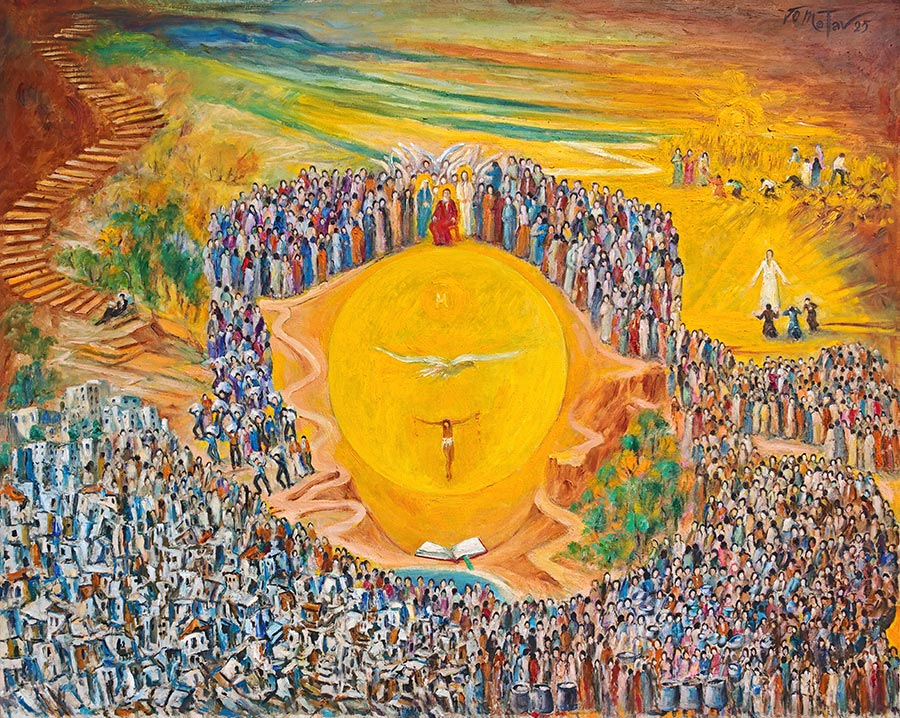
Between Earth and Heaven
On planet Earth, all roads lead to shadows. As for eternity, only one road leads us to God.
For several years, I have felt the need to address, through my artistic work, the theme of crime and the farcical nature of war in Gaza. Wars mobilize considerable resources, but above all, they raise fundamental human questions: the balance of power, respect for civilians, and the protection of homes, hospitals, and schools. Yet, in this war, these principles seem to have been ignored.
This conflict, often presented as a clash between two peoples, also evokes an older story: that of the descendants of Ishmael and Isaac, two brothers bound by a common origin, but divided by the fate of Jerusalem, a sacred city, a symbol of final judgment and a spiritual ideal.
Faced with this reality, I undertook a long process of research, sketching, and reflection over more than three years. This gave rise to a first canvas in which I expressed my inner revolt, my anger, but also my humanism and my poetry. This work represented total, brutal, almost instinctive destruction, because destroying is easier than building, since there are no rules, no laws, no constraints.
This first canvas eventually left my studio. Its departure left a profound void, but also a need: to continue reflecting and to create a new work, more accomplished, more structured, and perhaps more meaningful.
This is how this second canvas came to be.
Unlike the first, which focused on destruction, this new work seeks to articulate human suffering with a spiritual and universal dimension. It is organised according to a secret geometry that structures the composition.
In the centre, an immense crowd symbolises humanity, confronted with war, poverty, and famine. Some carry pots and plates, searching for food, a direct image of distress.
On the right, a wheat field evokes life, sustenance, and hope. On the left, multiple roads stretch out, representing human choices, possible directions, and the destiny each person forges.
The entire composition is organised around a vertical axis that connects earth to heaven:
- At the top, paradise, with the Heavenly Father surrounded by the Virgin Mary, angels, and saints
- Below, a luminous circle symbolising the Eucharist, the link between the divine and the human
- Then the Holy Spirit, in the form of a dove
- Next, Christ the Redeemer
- And finally, on a human level, the crowd suffers, but also hopes
Biblical and spiritual references are also present: Jacob’s Ladder, a symbol of the passage between the earthly and heavenly realms, and scenes inspired by the life of Christ, integrated into the composition.
At the heart of this crowd appears a spherical form, evoking planet Earth itself: a humanity gathered together, yet fragmented, confronted with its own contradictions.
This work was born from a profound need for expression. It required time, perseverance, and even periods of interruption due to personal constraints. But it imposed itself as an inner necessity.
I didn’t just want to represent war, but also to remind people that amidst the chaos, a light remains: the light of hope, faith, and the human capacity to overcome hatred.
I thank God for allowing me to paint, write, and share these reflections with an audience I cherish.
For, beyond differences, if people respected the fundamental principles of justice, compassion, and love, they could overcome conflicts and transform the world.
Joseph Matar
Adaptation by Google Translate