

The Roads of the Soul
Pilgrimages, Memory, and the Paths of Lebanon
By Joseph Matar
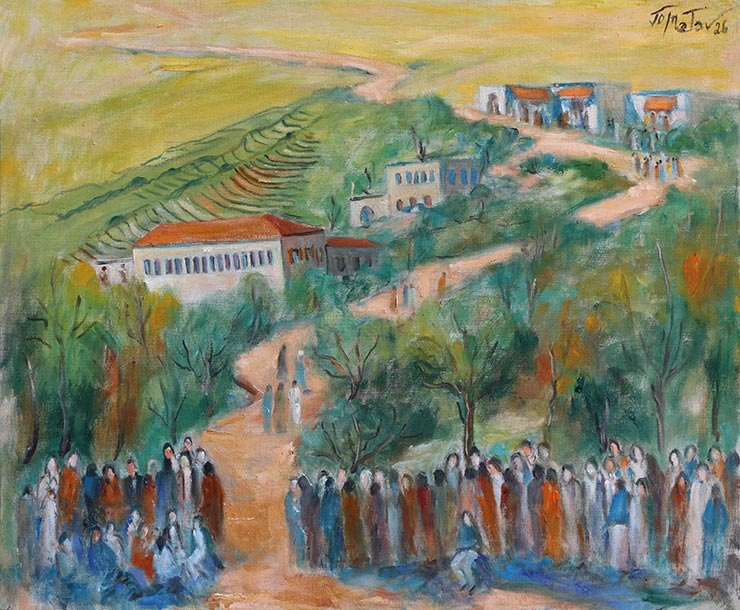
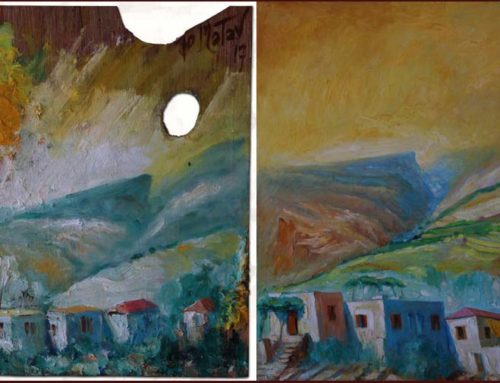
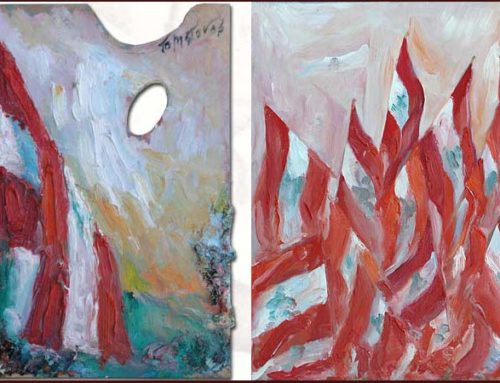
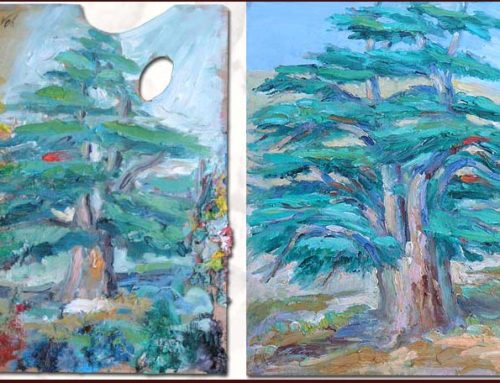
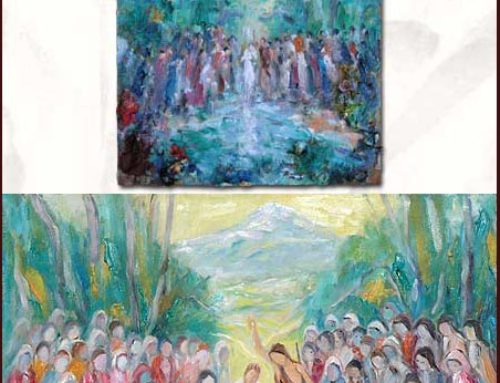
Oil painting on canvas, 60×73 cm
Some roads lead from one village to another, some connect cities, and others let one cross a country. But there are also roads of a different kind: paths that lead people toward themselves, toward their memories, toward their beliefs, and sometimes, toward God.
Pilgrimage routes belong to this latter category.
Since time immemorial, people have walked toward places they consider sacred. Pilgrimage exists in every latitude, in every culture, and in every religion. It belongs to humanity’s heritage, to its most ancient traditions, to this profoundly human need to leave, for a few days, the tumult of daily life in order to seek something else: silence, peace, meaning.
In Lebanon, new paths are beginning to rediscover this purpose. Routes already connect some major spiritual sites, such as Byblos to Saint Rafka, or the roads leading to Annaya and Saint Charbel. Tomorrow, others could traverse the entire country. For Lebanon seems to have been created for this. One only needs to leave the main roads to find footpaths, forests, valleys, rocky outcrops, and villages. There, no more cars, no more motorcycles, no more mechanical noise. What remains are the trees, the wind, the birds, flocks of goats and sheep, gardens laden with apples and pears, flowers around old houses, the water of streams, and farmers at work.
The walker traverses all of this slowly. He encounters a donkey laden with provisions, a farmer, an athlete, a couple, a group of pilgrims sitting in the shade. He hears the bells of a village, the rustling of leaves, or simply his own footsteps. A journey of over a hundred kilometers is not like a highway. It takes six, eight, sometimes ten days. You have to walk, stop, eat, sleep, contemplate, and then get back on the road. You have to accept the rhythm of man, which is almost that of a donkey: an ancient rhythm, forgotten by our time.
And perhaps that is precisely what people come looking for. Walking then becomes a way to escape, not the world itself, but its frenetic pace. A way to reconnect with nature, to meditate, to breathe, to find respite from this contemporary madness that constantly compels us to go faster.
On these paths, distances take on a different meaning. We no longer simply count the kilometers. We count the encounters, the villages we pass through, the nights spent in a convent or a small inn, the landscapes discovered around a bend in the trail.
These routes must therefore be conceived as genuine human itineraries: ensuring the safety of walkers, providing rest areas, simple accommodations, places to eat, medical care in case of emergency, and information about villages and monuments.
For these paths will not be used solely by believers. They will welcome Lebanese people from all communities, foreign visitors, and lovers of nature, history, and heritage. They can become paths shared by all.
The Memory of a Path
When I think of those roads, I see myself as a child again. I was seven years old. With my brothers, sisters, a few neighbors, and some friends, we formed a group of about twelve or fifteen people. We would set off on foot to visit my maternal aunt, Sister Mélanie, a nun at the Saint-Élie convent near Jeïta.
In those days, walking was second nature. We would leave our house and cross the paths from Ghadir to Zouk, then Antoura, before taking the shortcuts that led up to the convent. An hour, maybe a little longer. But what an hour! We would gather thyme and medicinal herbs for herbal teas. Sometimes we would find strangely shaped stones, like seashells. I kept some of them for years.
Before we left, we would also prepare what we were going to give to the nuns. In our garden, we would pick several kilos of myrtle. My mother would bake a beautiful cake. Everyone brought something. When we arrived, the nuns welcomed us with open arms. First and foremost, we would go into the church of Saint-Élie. Then came breakfast, conversations, games, and laughter. At noon, we ate lunch in a room next to the refectory. The whole day felt like a celebration. My aunt was happy to see us. We visited her several times a year. Later, when I finally bought a car, she was no longer there!
But my connection with the convent was never completely severed. These nuns were cultured women, often university graduates. Several had written books and asked me to design the covers. I did so with affection. Even today, Saint-Élie remains in my memory. Age and fatigue no longer allow me to take these walks as I once did, but the paths remain within me.
Before Modernity
Before Lebanon fully embraced modernity, Lebanese people walked a great deal. They walked to visit their families, to work, to pray, to travel from one village to another. When the distance was too great, they would stay with relatives and return home only two or three days later.
The road wasn’t simply a space between two places. It was part of the journey. Today, we have gained speed, but perhaps we have lost something of this relationship with time, with the landscape, and with others. This is why I have long believed that genuine religious and cultural tourism could, and even should, develop in Lebanon.
When I was still a student at the Marist school in the 1950s, I was already imagining paths, shortcuts, and routes that would allow believers to reach their holy sites by traversing nature. Today, this idea could become a reality.
A Lebanon Cross-Crossed by Paths
Imagine footpaths traversing Lebanon from north to south. Paths connecting convents, churches, monasteries, shrines, mosques, historical sites, museums, and ancient villages. Paths where no one would ask a walker about their religion or nationality. On such a path, differences fade away.
The millionaire can walk beside the poorest man. The foreigner can share bread with the villager. The deeply religious can walk alongside the one who still doubts. Walking puts men on an equal footing. We all have the same feet, the same weariness, the same thirst, the same need to rest in the shade.
On these paths, there should be no invisible borders or sectarian barriers. Everyone would walk with their convictions, their prayers, their silence. Lebanon could thus offer the world a different face: that of a small country where religious traditions, nature, culture, and hospitality converge. Other countries have already grasped the power of these pilgrimages. Thousands of people walk to Santiago de Compostela. Crowds flock to Lourdes and Rome. Some set out out of faith; others seek only a few days of silence and introspection. For even when humankind believes it has conquered everything, it continues to seek peace for its soul.
A road is never just a road.
There is the road to Rome.
The road to Victory.
The road to Glory.
The road to Paradise.
There are roads that lead to happiness and others to suffering.
But some paths carry within them something greater than their destination.
They have a soul!
On the pilgrimage, one learns not to judge the person walking beside them.
One learns to help, to forgive, to love. One learns that one can possess little and receive much.
Every fountain becomes a gift. Every tree becomes shelter. Every village becomes an encounter. Every person met can become a companion for a few kilometers.
And little by little, the road transforms those who travel it. It teaches them patience, simplicity, courage, friendship, and hope.
That is why these paths could become much more than a tourism project. They could contribute to a new way of seeing Lebanon.
A country traversed not only by highways and cars, but also by men and women who take the time to walk. A country whose sanctuaries, villages, nature, and history would be linked by paths of peace.
Along these paths, love, hope, kindness, knowledge, and courage could be sown in the souls of those who travel them. For perhaps the most beautiful paths are not those that allow us to go the fastest. They are those that, step by step, lead us back to what truly matters.
Joseph Matar
All rights reserved © LebanonArt